
Go2 RL RobotLab




Overview
Train a Unitree Go2 robot in IsaacLab, and deploy policy to MuJoCo for Sim2Sim. For more, see the project page.
It is an official MoE-CTS algorithm implementation in IsaacLab / RobotLab, as a reproduction of go2_rl_gym.

Demos
Train in IsaacLab → validate with MuJoCo Sim2Sim → evaluate on the real Unitree Go2.
|
IsaacLab Play Policy rollout in the IsaacLab environment. 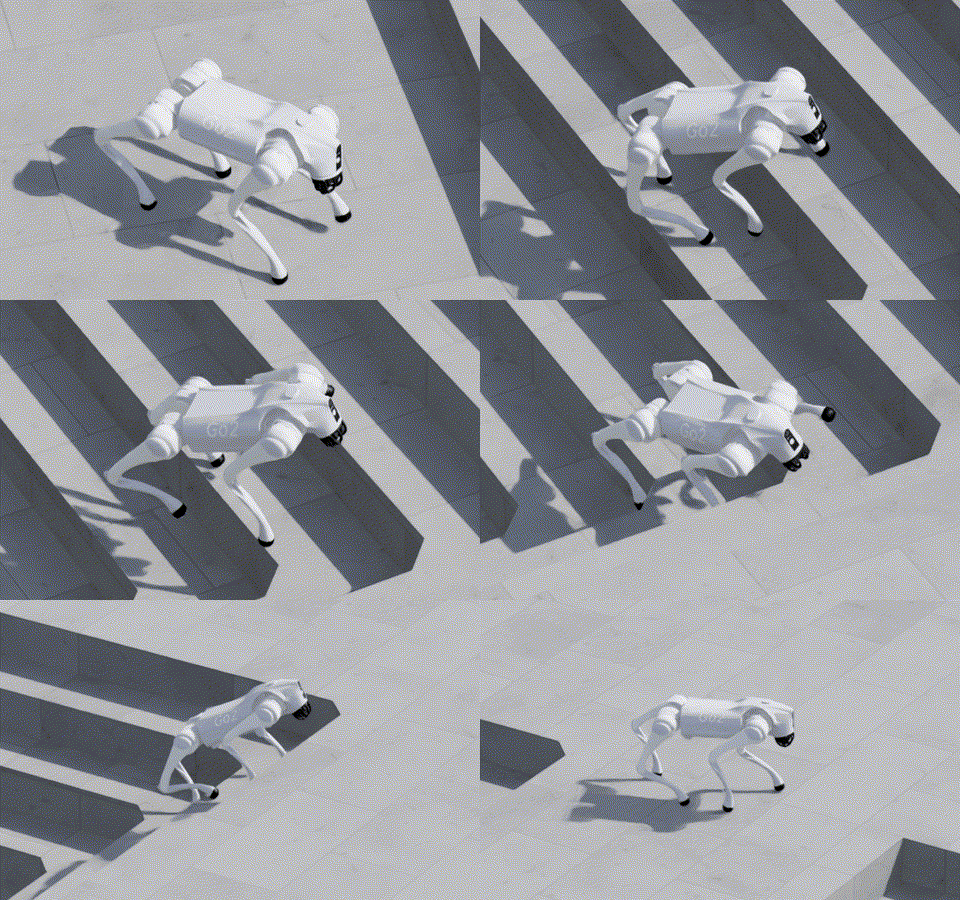
|
MuJoCo Sim2Sim Exported policy running in MuJoCo before real-world deployment. 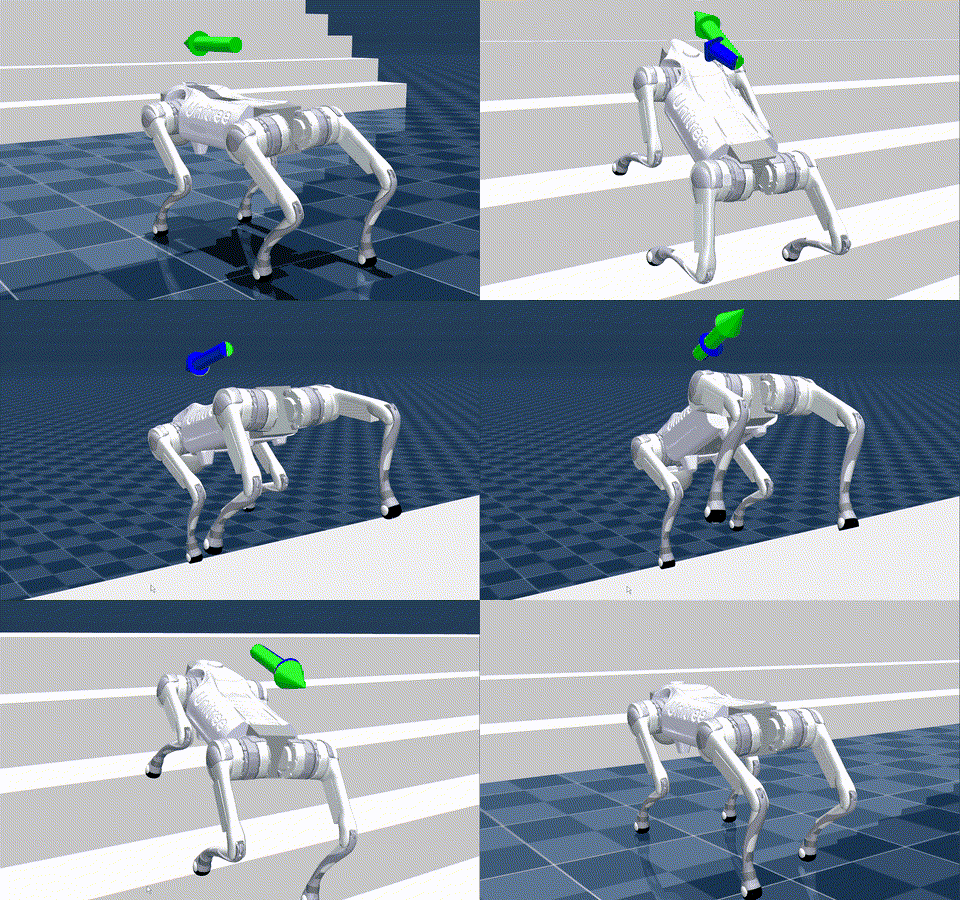
|
|
Real Robot Robust walking front on stairs. 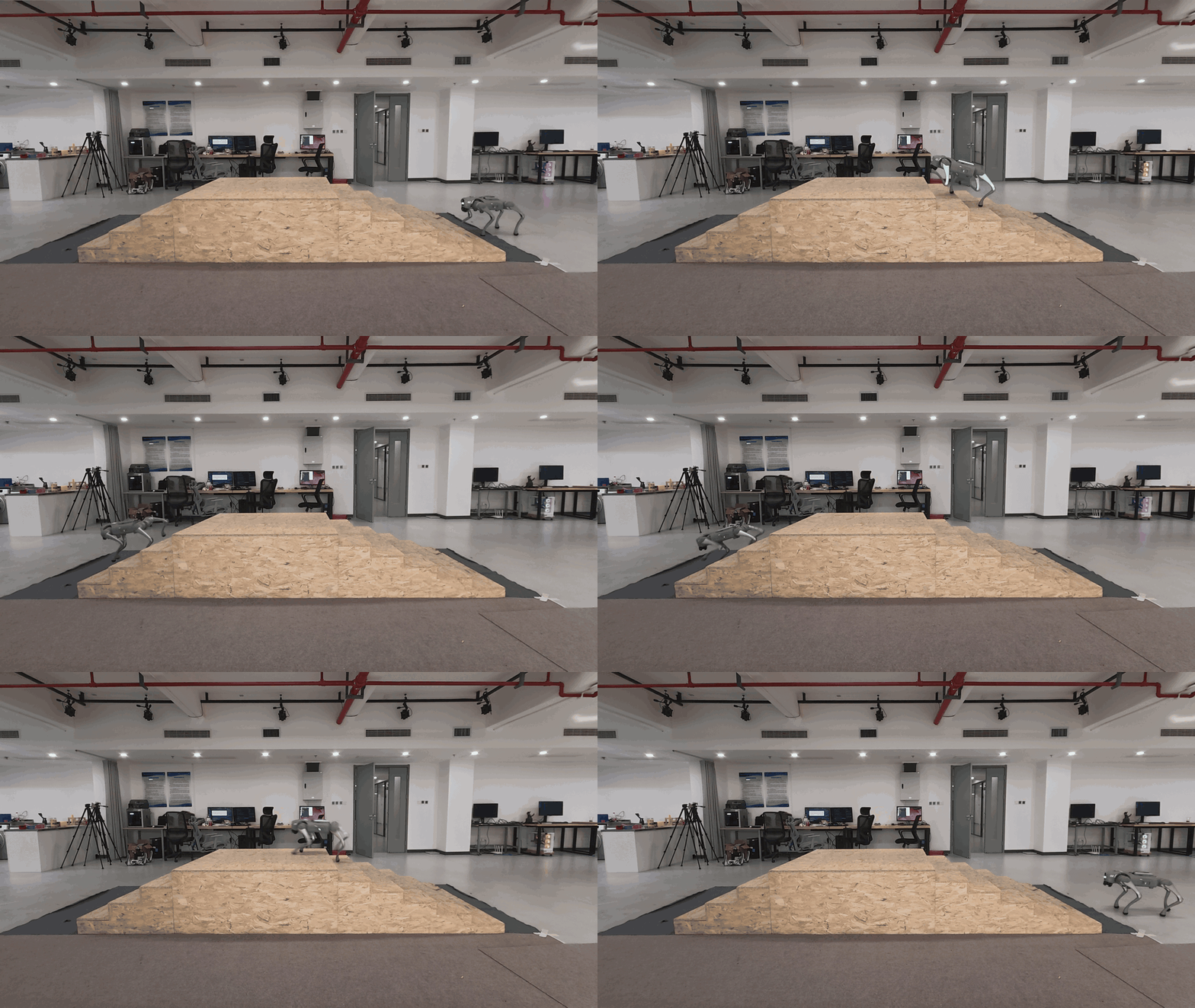
|
Real Robot Robust walking sideways on stairs. 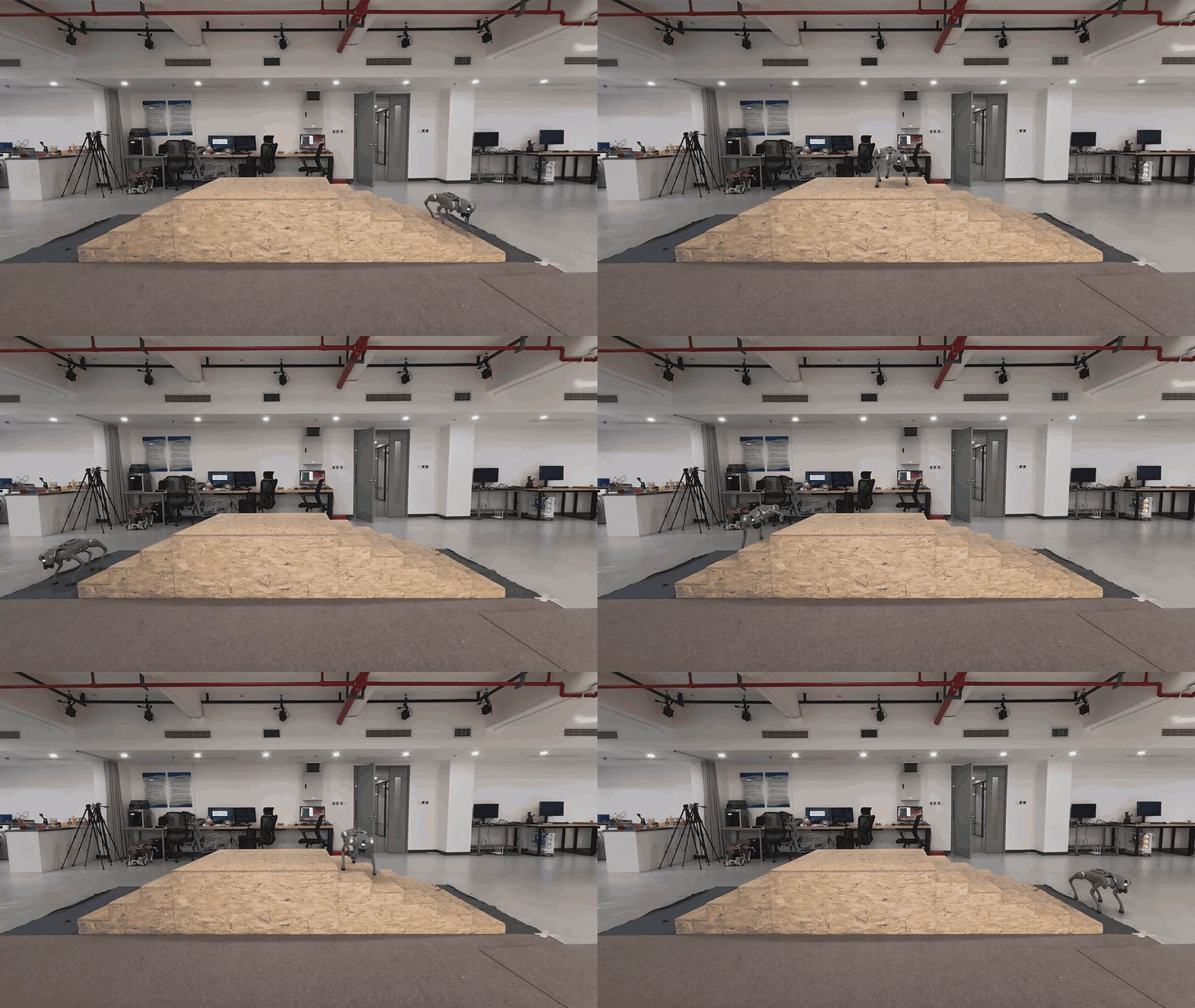
|
RoboGauge Benchmark
RoboGauge score comparison between go2_rl_robotlab and the original go2_rl_gym.

Algorithm Results (Best Checkpoint Results)
| Model | Score | Tracking | Safety | Quality | Level |
|---|---|---|---|---|---|
| go2_moe_cts (go2_rl_robotlab) | 0.6984 | 0.7055 | 0.8159 | 0.7693 | 8.30 |
| go2_moe_cts (go2_rl_gym) | 0.6713 | 0.6669 | 0.7857 | 0.7392 | 7.85 |
| CTS vanilla | 0.5786 | 0.5755 | 0.7066 | 0.6624 | 6.83 |
| HIM | 0.5379 | 0.5453 | 0.6476 | 0.6050 | 6.19 |
| DreamWaQ | 0.5054 | 0.5105 | 0.6149 | 0.5730 | 5.74 |
Installation Guide
1. Install IsaacLab
Install IsaacLab follow official guide:
conda create -n go2_rl_robotlab python=3.11
conda activate go2_rl_robotlab
pip install --upgrade pip
pip install isaaclab[isaacsim,all]==2.3.2.post1 --extra-index-url https://pypi.nvidia.com
pip install -U torch==2.7.0 torchvision==0.22.0 --index-url https://download.pytorch.org/whl/cu128
2. Install Customized RSL-RL and RobotLab
We uses a customized version of rsl_rl==3.3.0 and robot_lab==2.3.0. Install them in editable mode:
python -m pip install -e source/robot_lab
python -m pip install -e source/rsl_rl
3. Install MuJoCo (Optional, for Sim2Sim)
To enable MuJoCo-based simulation:
pip install mujoco pygame # tested on 3.4.0 and 3.6.0
Training and Evaluation
Run the following commands:
# Train
python scripts/rsl_rl/train.py --task=RobotLab-Go2-v0 --headless

# Evaluate
python scripts/rsl_rl/play.py --task=RobotLab-Go2-v0
The Go1 adaptation is available on the go1 branch as
RobotLab-Go1-v0; see docs/go1.md for its training, export,
observation, and MuJoCo deployment details.
Training with RoboGauge Evaluation
RoboGauge provides an asynchronous suite for evaluating motion-control reinforcement learning policies, helping you select the best model. After installing RoboGauge by following the installation guide, start the RoboGauge server:
python robogauge/scripts/server.py --port 9973 --num-processes 32
In another terminal, start your training with RoboGauge evaluation enabled:
# Train
python scripts/rsl_rl/train.py --task=RobotLab-Go2-v0 --headless --robogauge --robogauge_port 9973
Note on Asynchronous Evaluation:
Since the evaluation runs asynchronously, the training loop receives the results from the previous evaluation in the next iteration. If evaluation is slower than training, tasks will be queued. Upon training completion, the process will wait for all remaining evaluation tasks to finish before exiting.
Performance Example: On a system with an AMD EPYC 7763 and RTX 4090, a full evaluation takes approximately 5 minutes with num_processes=63. Training and saving checkpoints every 500 steps typically takes around 30 minutes.
Configuration
The training pipeline can be configured at two levels: task-level Python configuration files and runtime arguments passed to the training script.
Task-Level Configuration
The default task settings are defined in the following files:
-
Environment configuration
source/robot_lab/robot_lab/tasks/go2/env_cfg.py -
RL algorithm configuration
source/robot_lab/robot_lab/tasks/go2/rsl_rl_cfg.py -
Task registration
source/robot_lab/robot_lab/tasks/go2/__init__.py
Runtime Overrides
In addition to the default configuration files, train.py and play.py supports several command-line arguments for runtime overrides:
python scripts/rsl_rl/train.py \
   --task=RobotLab-Go2-v0 \
   --headless \
   --experiment_name <YOUR_EXP_NAME> \
   --run_name <YOUR_RUN_NAME> \
   --num_envs <NUM_ENVS> \
   --checkpoint <PATH_TO_CHECKPOINT>
For more details, refer to the robot_lab repo.
MuJoCo Sim2Sim
Set the policy_path in deploy/deploy_mujoco/configs/go2.yaml:
policy_path: "{ROOT_DIR}/deploy/pre_train/go2/xxx.pt" # policy.pt exported by running scripts/rsl_rl/play.py
Run the deployment script:
python deploy/deploy_mujoco/deploy_go2.py
Controller Behavior
- Automatic detection: If a controller is connected, control mode is enabled automatically.
- Fallback mode: If no controller is detected, default commands from the config file are used.
Controller Mapping
| Input | Function |
|---|---|
LX / LY |
Forward / lateral velocity |
RX |
Angular velocity (steering) |
Switching Simulation Scenarios
Modify xml_path in deploy/deploy_mujoco/config/go2.yaml:
# Flat terrain
xml_path: "{ROOT_DIR}/resources/go2/flat.xml"

# Stairs
xml_path: "{ROOT_DIR}/resources/go2/stairs.xml"

# Boxes
xml_path: "{ROOT_DIR}/resources/go2/boxes.xml"

# Custom
xml_path: "{ROOT_DIR}/resources/go2/your-custom-scene.xml"
Differences from go2_rl_gym
- Motor:
- use official unitree motor model instead of simple PD controller.
- Rewards:
- 2x tracking reward weights due to better performance.
- different tracking reward form (fixed sigma vs. dynamic sigma).
- lower joint_acc_l2 weight in Lab due to physics-step level implementation and sensitivity to outliers.
- extra joint_pos_penalty_l1 reward in Lab due to better performance.
- Domain randomization:
- no randomized action delay, use motor-level delay instead.
- no motor strength randomization due to implementation constraints in Lab.
- History length: 10 in Lab vs. 5 in Gym, due to better performance with longer history in Lab.
- Terrain Difficulty: use lab's continuous difficulty levels.
Acknowledgements
This repository would not exist without the following open-source projects:
- isaac_lab: Unified framework for robot learning built on NVIDIA Isaac Sim.
- rsl_rl: Reinforcement learning algorithms.
- robot_lab: RL Extension Library for Robots, Based on IsaacLab.
- mujoco: High-performance CPU physics simulator.
Related publications implemented in this repo: